

The counterintuitive part of installing a crypto wallet is that the installation itself is usually the easy step. The difficult question is what the wallet can help you understand before you sign. In a multi-chain DeFi transaction, the visible button may say “Confirm”, while the underlying action could involve a token approval, a contract call, a bridge route, or an exchange of assets at an unfavourable price. Rabby’s browser wallet is designed around that gap between what a decentralised application displays and what a transaction may actually do.
For German-speaking DeFi users, this matters especially when one working week involves Ethereum, Arbitrum, Base, Polygon or the BNB Chain rather than a single network. Rabby positions itself as a non-custodial alternative to MetaMask, with more emphasis on transaction simulation, risk warnings and multi-chain navigation. That does not make it a magic security layer. It does, however, offer a useful mental model: a wallet should not merely transmit a signature; it should help the user inspect the consequences of that signature.
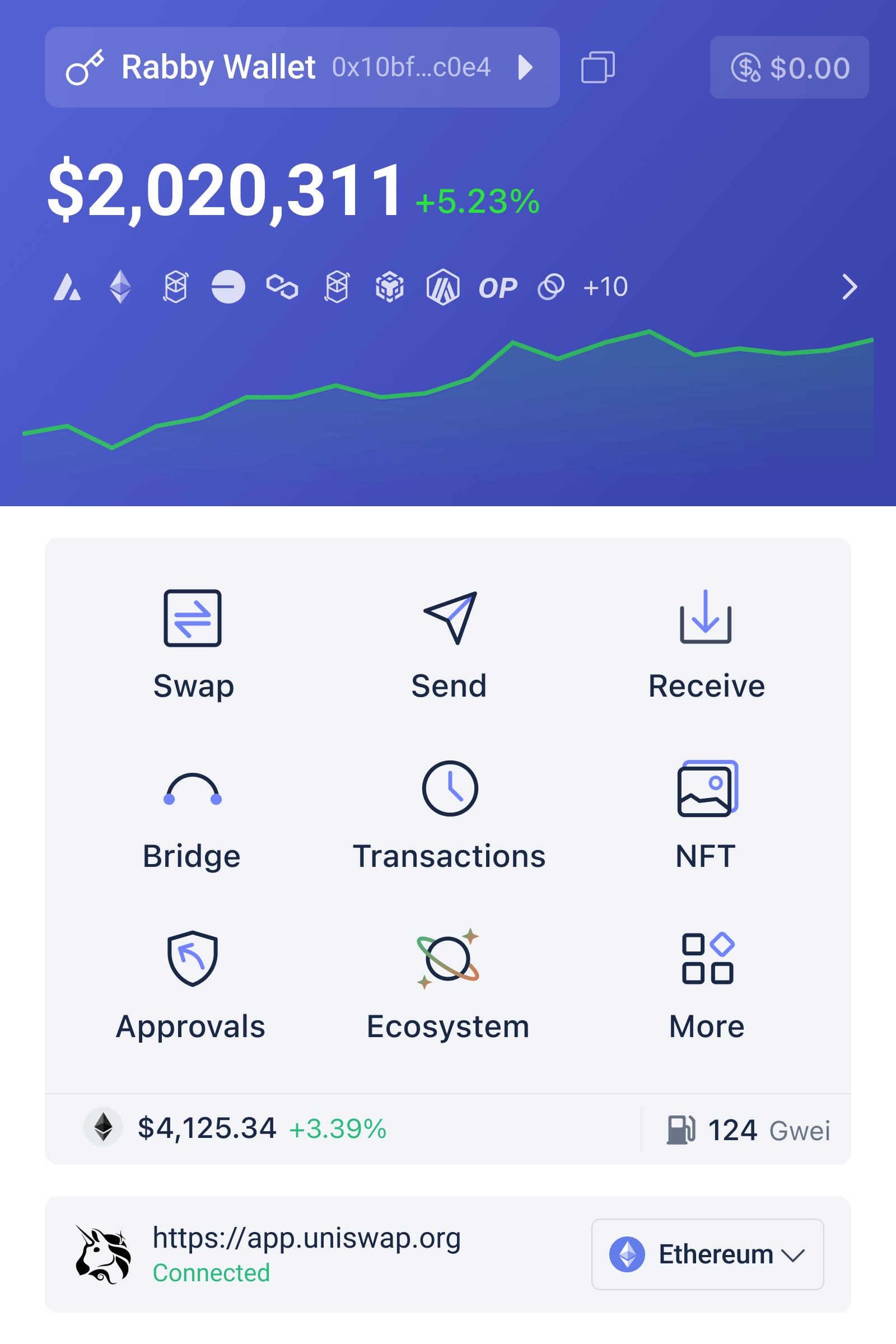
What happens when you install the Rabby Chrome extension?
Rabby is primarily available as a browser extension for Chrome, Brave and Edge, alongside desktop applications for Windows and macOS and mobile applications for iOS and Android. To install Rabby in Chrome, a user should obtain the extension from an official source, verify the publisher and check that the browser displays the expected permissions before adding it. This basic discipline is not cosmetic: fake wallet extensions are a well-known attack path because they can imitate familiar branding while attempting to capture recovery phrases.
After installation, Rabby can create a new wallet or import an existing one. In either case, the recovery phrase is the critical security boundary. Rabby follows a non-custodial model, meaning private keys are stored locally on the user’s device rather than transmitted to Rabby’s servers. The practical consequence is both empowering and demanding: Rabby cannot simply reset access for a user who loses the recovery phrase, and malware or poor device security can still threaten locally stored credentials.
A safer setup for meaningful funds is to connect a hardware wallet such as Ledger, Trezor or OneKey. The browser extension can then provide the interface and transaction analysis, while the hardware device retains control of the signing key. This division is important. A hardware wallet does not decide whether a DeFi contract is trustworthy, and a software interface does not remove the need to approve the final transaction on the device. Security improves when these roles are understood rather than blurred.
Users looking for a practical starting point can review the rabby wallet installation path, but should still verify downloads independently and never enter a seed phrase into a website, chat window or support form. A genuine wallet provider will not need the phrase to “activate” an account.
Why Rabby’s transaction simulation is more than a convenience
Transaction simulation is the feature that most clearly distinguishes Rabby’s design philosophy. Before signing, the wallet simulates the proposed call and presents expected changes to token balances. Instead of seeing only an abstract contract address and a gas estimate, the user may see that one asset is leaving the wallet, another is arriving, or an approval is being created. This translates smart-contract execution into a question ordinary users can answer: “Is this the outcome I intended?”
The underlying insight is that transaction security is partly a comprehension problem. Many losses do not begin with an obviously malicious pop-up. They begin with a user misunderstanding an approval, selecting the wrong network, overlooking slippage or assuming that a familiar dApp URL guarantees a safe contract. Rabby’s integrated security engine checks contracts and addresses for signals associated with phishing, known hacks and potentially dangerous infinite approvals. Its warnings can therefore act as a second opinion at the moment when attention is most valuable.
There is a boundary, however. A simulation is a forecast of how a transaction is expected to behave under the simulated conditions; it is not a legal or economic guarantee. Contract state can change between simulation and inclusion in a block. A protocol can be technically functioning while still exposing users to governance, oracle, bridge or liquidity risks. A warning engine can identify known patterns, but it cannot prove that an unfamiliar protocol will remain solvent or that an economic strategy is sensible. The right habit is to treat simulation as an inspection tool, not as an insurance policy.
That distinction is particularly relevant for bridges. Rabby integrates bridge routes through services such as LI.FI, allowing users to move assets between networks from within the wallet interface. This reduces friction, but it does not eliminate bridge risk. A cross-chain transfer involves more than moving a coin from one account to another; depending on the route, it can involve intermediaries, messaging systems, wrapped assets and different liquidity conditions. A convenient interface can make a complex route legible, but users should still inspect the destination chain, received asset and estimated fees.
Multi-chain convenience: where Rabby gains an edge
Rabby supports more than 140 EVM-compatible networks, including Ethereum, Polygon, Arbitrum, Optimism, Avalanche, Base and BNB Chain. EVM refers to the Ethereum Virtual Machine, the execution environment used by Ethereum and many compatible networks. This broad support is useful for users whose assets and applications are spread across several ecosystems. Automatic network switching can also remove a common source of confusion: connecting to a dApp on one chain while the wallet remains set to another.
Yet automatic switching has a subtle trade-off. Fewer manual steps mean fewer opportunities to make a network-selection mistake, but they can also reduce deliberate attention. Before signing, users should still ask which chain they are on, which asset is being spent and whether the dApp is expected to operate there. Convenience is safest when it removes repetitive work, not when it replaces understanding.
Rabby also includes an integrated swap aggregator that scans decentralised exchange venues such as Uniswap and 1inch for routes. In principle, aggregation can improve execution by comparing liquidity and potential slippage rather than relying on one venue. In practice, the best quoted route may involve more contract interactions, different fees or a less familiar intermediary. “Best price” is therefore not identical to “lowest risk” or “simplest transaction”. A careful user compares the net outcome, approval requirements and route complexity.
The Gas Account feature addresses another practical problem in multi-chain DeFi: holding the native token required to pay transaction fees. Where supported, users can pay gas across networks with stablecoins such as USDC, even when they do not have the relevant native asset. This can make a wallet more usable for newcomers and reduce the need to maintain small balances on many chains. It may also hide an important operational fact: fee payment is being abstracted, not abolished. Users should understand the conversion, eligibility and network conditions before relying on the feature for time-sensitive transactions.
Rabby compared with other wallet choices
Compared with MetaMask, Rabby’s main difference is emphasis rather than a completely different category of product. Both can serve as non-custodial interfaces for EVM applications, but Rabby focuses more strongly on multi-chain presentation, simulation and security warnings. MetaMask may remain the more familiar choice for users whose applications, tutorials or hardware setup are already built around it. The trade-off is that familiarity can reduce friction, while Rabby’s more detailed review flow may require a little more reading before each signature.
A hardware wallet is not a direct substitute for Rabby but a different layer. It protects key use by keeping signing authority on a separate device, whereas Rabby helps interpret the transaction and connect it to a browser-based application. For larger portfolios, combining the two can be more robust than choosing between them. The remaining limitation is human: a user can still approve a malicious or economically harmful transaction on a hardware device if the transaction is misunderstood.
A custodial exchange offers yet another model. It can simplify buying, selling and account recovery, but the platform controls the keys and generally cannot provide the same direct interaction with DeFi contracts. Rabby gives users more control and more composability, but also assigns them responsibility for seed storage, phishing resistance, network selection and protocol risk. The relevant choice is not simply “which wallet is safest?” It is “which responsibilities am I prepared to manage?”
Rabby’s open-source architecture, released under the MIT licence, allows the community to inspect the software. That is a meaningful transparency property, but open source should not be confused with automatic safety. Code can be reviewed unevenly, dependencies can introduce risk and a secure application can still be used with a compromised browser or a fraudulent website. The strongest interpretation is modest: openness improves the conditions for scrutiny; it does not guarantee that every problem has been found.
A practical framework for using Rabby safely
Before signing, separate four questions that are often compressed into one click. First, identity: am I connected to the intended dApp and contract? Second, authority: am I transferring assets or granting an approval? Third, outcome: do the simulated balance changes match my intention? Fourth, context: is the chain, fee, slippage and bridge route appropriate? This four-part check remains useful even when Rabby presents reassuring warnings.
Users should also maintain a small-value testing habit. On a new chain or unfamiliar protocol, a limited transaction can reveal whether the route, token and recipient behave as expected. Revoke unnecessary approvals when appropriate, keep browser software updated and store recovery material offline. Rabby Points, earned through activities such as swaps, gas top-ups or referrals, may add a loyalty-game element, but rewards should never be the reason to increase exposure or interact with an untrusted protocol.
Recent Rabby messaging continues to present the wallet as a broad Ethereum and EVM interface for Chrome and Brave users. The more durable question is whether the product’s analysis features keep pace with increasingly complex transactions. If DeFi interfaces continue combining swaps, approvals, lending and bridging into single flows, simulation and clearer warnings could become less of a differentiator and more of a basic expectation. That outcome depends on the quality of the simulations, the coverage of the warning systems and whether users actually read the information presented.
Frequently asked questions
Is Rabby safer than MetaMask?
It is more accurate to say that Rabby offers a different safety-oriented user experience, with strong emphasis on transaction simulation, multi-chain context and risk warnings. That may help users detect misunderstandings earlier, but it does not remove smart-contract risk, phishing, compromised devices or poor signing decisions. Safety depends on the wallet, the device, the protocol and the user’s verification habits.
Can I use Rabby without holding native gas tokens?
In supported situations, Rabby’s Gas Account can allow fees to be paid with stablecoins such as USDC across networks. Availability and conditions can vary, so users should inspect the displayed fee method before confirming. The feature reduces operational friction, but it does not change the underlying network mechanics or make every transaction free.
Does Rabby’s simulation guarantee that a transaction is safe?
No. Simulation shows expected execution and balance changes, while the security engine flags recognised risk signals. Neither can guarantee protocol solvency, future contract behaviour, favourable economics or protection from every novel attack. Use the result as a structured review, then consider the dApp, route, approvals and amount separately.